
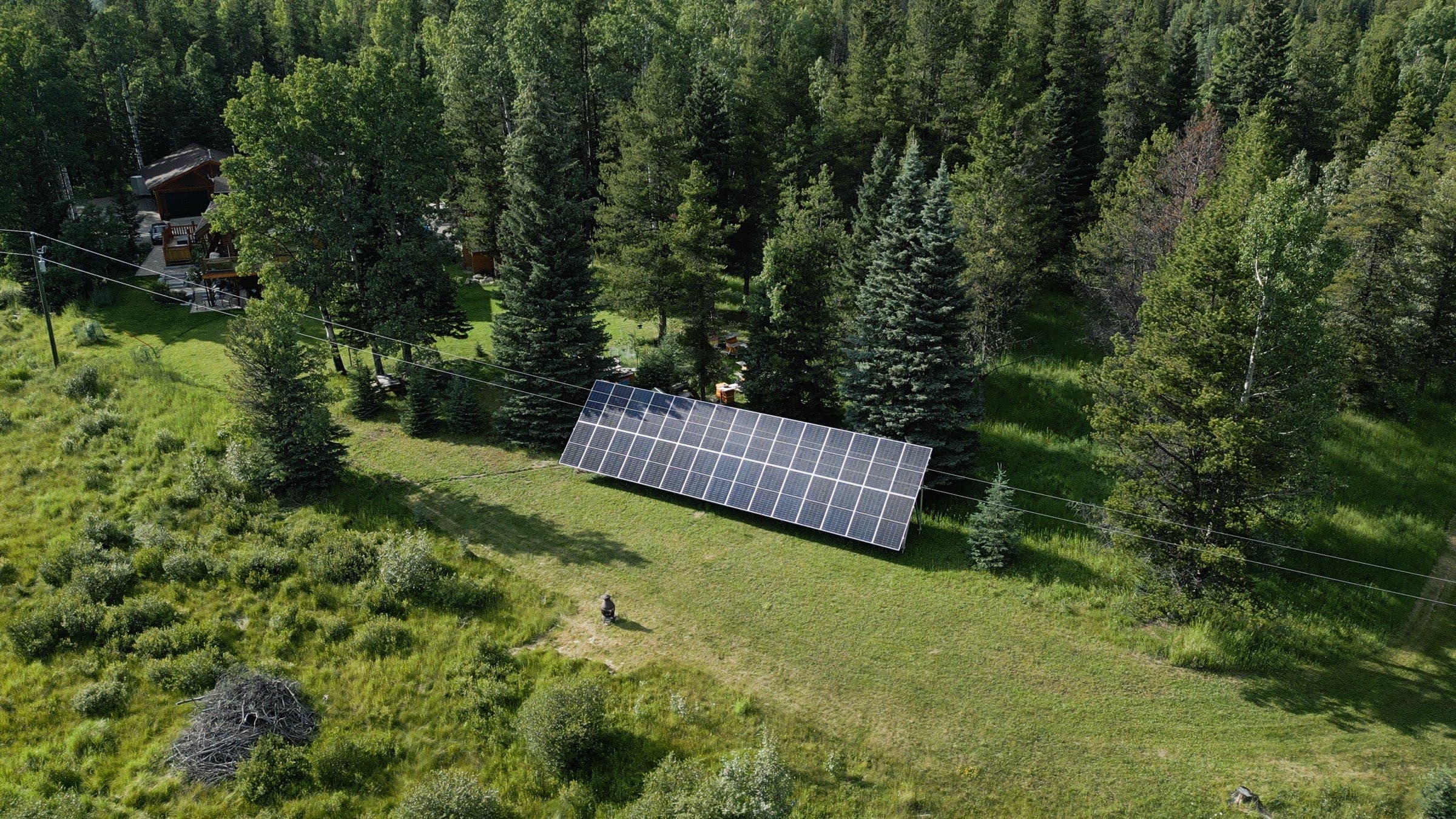
Farms, acreages and agricultural businesses
Rural solar installation in Alberta
You have the land and the sun. We design and install the part in between: hail-rated, wind-engineered systems for farms and acreages across southern Alberta, assessed in person by the person who designs them.
Get a free quote
The grid has changed, and so has the math
In rural Alberta you don’t just pay for power, you pay to have it delivered, and delivery is the part of the bill that keeps rising. The Alberta Utilities Commission approves the transmission and distribution rates; the Utilities Consumer Advocate publishes what they add up to. On many acreages that’s more than the electricity itself. The old way of powering a property has become a cost you can’t control. Making your own power is the one you can.
Why your neighbours are switching
The delivery charge is the bill
On a rural service, transmission and distribution often cost more than the electricity they deliver. Every kilowatt-hour you make yourself is one you didn't pay to have trucked down the line.
The sun is already on your land
Southern Alberta has some of the best solar potential in the country, and a quarter section has no shortage of places to put panels. A ground mount can be aimed exactly where a roof can't.
A fixed price for power
Diesel, fertilizer and the utility all go up. An array is twenty-five years of electricity bought at today's price, and it doesn't send a bill in March.
Are we the right fit?
We’re probably not the right people if
You want a kit to install yourself
Solar is high-voltage electrical work on a structure. We design, permit, install and have it inspected. We don't sell parts.
You need a few panels for an off-grid cabin
Our systems are grid-tied and sized to export. Small recreational setups for an RV or a hunting cabin are a different trade, and we'll say so rather than sell you the wrong thing.
You're selling in the next year or two
Solar adds to a property's value the day it's switched on, but the math is best for owners who plan to hold the place at least five years.
If you farm, run an agricultural business, or own an acreage you’re staying on, and you want a permitted, engineered system that pays you back, we’re built for you.
Every property has a different goal
What’s yours?
Working farms
Lower operating costs on loads that run all day, a hedge against the next rate increase, and a capital asset you can write off.
Acreages
Get out from under the delivery charges, add to the property's value, and keep the house powered at a known cost.
Ag-business and processing
Predictable energy costs, a sustainability story your buyers are starting to ask for, and the corporate tax credits to pay for it.
For working farms: turn a tax bill into infrastructure
Farming is a margins business. You can’t set the price of diesel or fertilizer, but you can set the price of power for the next twenty-five years. For an active operation an array isn’t an expense, it’s a capital asset that produces something every day.
Accelerated write-off. A solar system falls under capital cost allowance class 43.1 or 43.2, which lets a corporation depreciate most of the cost quickly, in the years the income is highest.
The investment tax credit. Eligible farm corporations can claim the federal Clean Technology investment tax credit, a refundable credit of up to 30% of the capital cost. It isn’t a grant you apply for and hope; it’s tax law.
Loads that never stop. Aeration fans, shop heat, watering bowls and the yard light run around the clock. Those are the loads that make solar pay fastest, and on a farm there’s land to size the array to them.
Most farms end up with a ground mount. It can be aimed exactly, it clears of snow from the ground, and it doesn’t ask anything of an old barn roof.
For acreages: get out of the delivery charge trap
Living on an acreage shouldn’t mean paying three hundred dollars in distribution fees for a hundred dollars of electricity. You can’t disconnect the wire, but you can make the grid pay you through it. Alberta’s microgeneration rules credit you for what you export, and some retailers pay a high summer export rate. Sized to over-produce from spring to fall, the array builds a credit bank that covers not just your winter electricity but a good part of the fixed charges too.
- It can look good. Black-on-black panels and low-profile racking on a house roof read as an upgrade, not an eyesore.
- It’s worth money at sale. A house with a near-zero power bill is a different listing from the one next door.
- You don’t need a battery to save. The grid is your battery: summer production is banked as credit and spent on winter heat. Batteries are for when an outage costs you livestock or a freezer full of beef.
For ag-business and processing
Feedlots, greenhouses and processors run on energy, and energy is usually the largest variable overhead on the books. Solar brings it under control and gives you something to say when a buyer asks about emissions. The big grocery chains and processors increasingly want Scope 3 reporting from their suppliers; “solar powered” on the label is a real answer. Module-level monitoring puts production and consumption on a dashboard you can feed into whatever runs the rest of the operation, and the same 30% investment tax credit applies.
Built for chinooks, hail and harvest
We don’t install California systems in Alberta
Hail
Every panel we install is rated to IEC 61215, tested against 25 mm hail at highway speed. Where the risk is highest we can specify heavier-glass modules.
Wind
A chinook on an open section loads an array far harder than a city roof ever sees. Racking and attachments are engineered for the wind at your site, and ground mounts are set in footings sized for it.
Snow
Ground mounts are pitched so snow slides and are easy to clear with a brush from the ground. Roof arrays are laid out so sliding snow doesn't land where it shouldn't.
Who you deal with
We don’t send salespeople
Book an assessment and the person who shows up is Tyler Marriott, who founded the company and designs every system himself. He has spent years on rural electrical services, from three-phase power to aging pole-top transformers, and he’ll tell you on site whether the numbers work for your place.
The crew that installs is the crew you met. We live and work in Alberta and we don’t subcontract to an out-of-town outfit. One point of contact from design through permits, the utility application and the inspection. Our team has installed over 100 solar systems across Calgary and area since 2019.
In short
- Rural bills are often half delivery charges. Exporting at a high summer rate lets the array pay those fees down, not just the electricity.
- A farm corporation can claim the 30% federal clean technology investment tax credit and write the asset off fast under capital cost allowance class 43.1 or 43.2.
- An array locks in your electricity cost for twenty-five years or more.
- Unlike a power bill, it's an asset on the land, and it adds to what the place is worth.
- We install only hail-rated modules and racking engineered for Alberta wind and snow.
- Assessments are in person, on your property, by the person who designs the system.
Check the incentives yourself
Don’t take our word for it
Clean Technology Investment Tax Credit
The federal refundable credit of up to 30% of the capital cost for eligible corporations. Search "clean technology ITC" on canada.ca.
Capital cost allowance classes 43.1 and 43.2
How a solar asset is depreciated against taxable income, and how fast. Your accountant will know these by number.
Microgeneration and export rates
Alberta's microgeneration regulation sets how you're credited for exports. Retailers' high-export plans change; check the current rate before you count on it.
This is general information about programs that exist, not tax advice. Confirm your own eligibility with your accountant before you count on any of it.
You asked, we answered
- Do solar panels work in an Alberta winter?
- Yes, differently. Production drops in December and January with short days and snow cover, then runs well ahead of what you use from March to October. The system is sized against a full year of usage so the summer credits carry the winter. Cold air actually makes the panels more efficient; it's the short days, not the temperature, that cut production.
- What happens when it hails?
- The panels are tested against 25 mm hail at highway speed and usually come through a storm better than the roof around them. The array is covered under your farm or home insurance like any other structure on the property.
- Is the tax paperwork complicated?
- It can be, and we don't leave it to you. We prepare the technical documents for the investment tax credit and the microgeneration application, and we hand your accountant a package with the figures they need for the capital cost allowance claim. Confirm the tax treatment with them; we're installers, not accountants.
- Roof mount or ground mount?
- Whichever suits the site. A shop or barn roof is usually the cheapest option if the structure takes the load and faces the right way. A ground mount costs more per kilowatt but can be aimed properly, sized past what any roof allows, and cleared of snow from the ground. Most farms end up with a ground mount.
- How long does a system last?
- Panels have no moving parts and are built for twenty-five to thirty years or more. They carry a 25-year performance warranty: if they degrade faster than specified, they're covered. Inverters are the part that gets replaced, typically once over the life of the system.
- Can I add to it later if I build a new shop?
- Yes. We design with room to grow, so a new barn, shop or EV charger can be added to the existing array, subject to what your utility service can carry. Three-phase services and long runs to outbuildings are a normal part of the work.
Outbuilding roofs near the end of their life? We do roofing too, and it’s worth sorting before an array goes on top. In town, see solar for homes.
Stop renting your power. Start owning it.
Book a free on-site assessment. We come to the property, look at the service and the site, and come back with a system size and a payback figure worked from your actual bills.
Get a free quoteOr call 587-000-0000