
How it works
How solar works on an Alberta home
No batteries, no going off-grid. Your roof makes power, your meter counts both ways, and the grid banks the surplus for winter. Here's the whole thing in plain words.
Get a free quoteThe parts
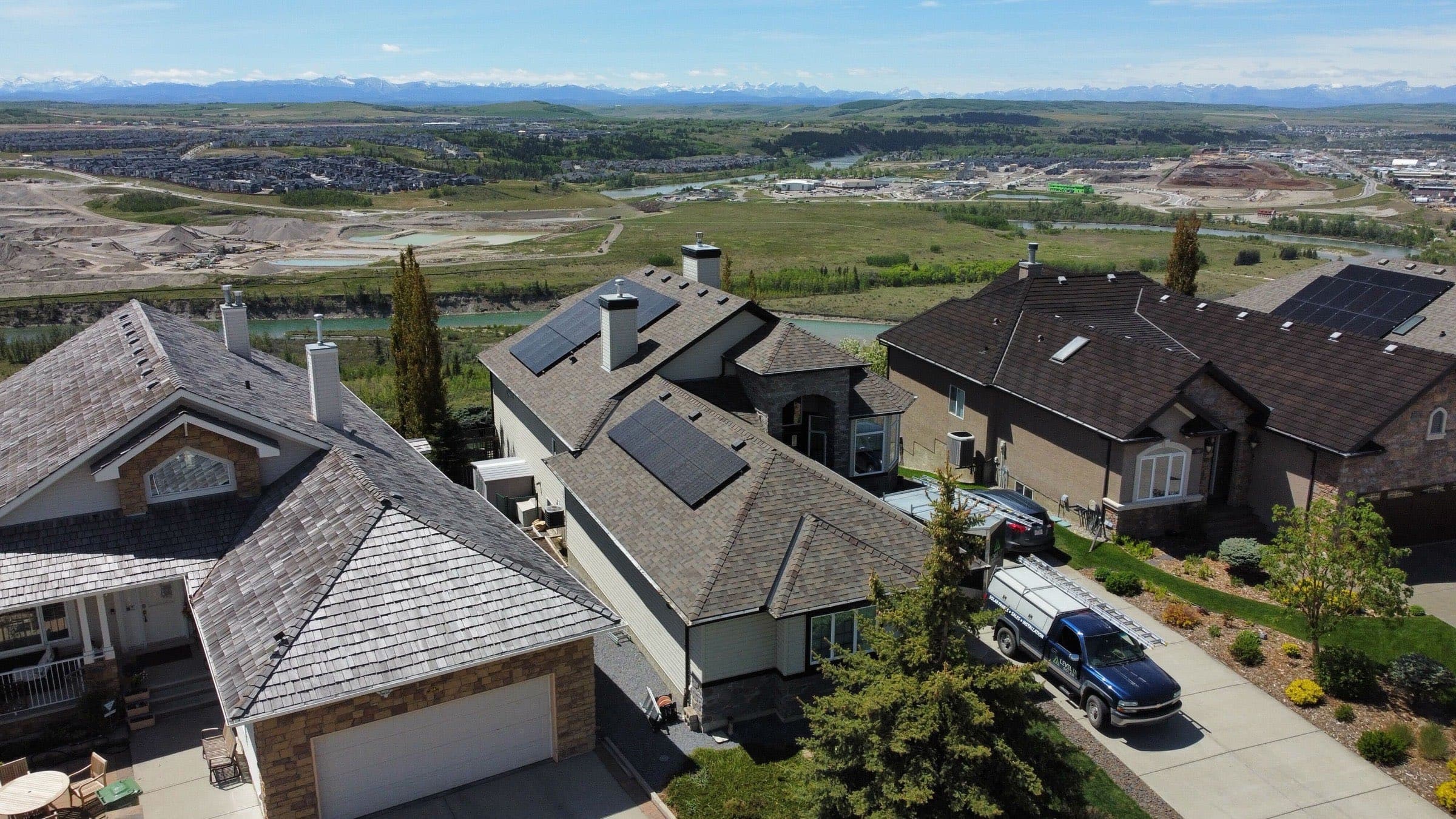
Panels on the roof turn sunlight into direct current. A microinverter under each panel turns it into the alternating current your house runs on, so one shaded or failed panel doesn’t drag the others down. The power runs to your electrical panel and feeds whatever is on in the house. Anything left over goes out through your meter to the grid. A monitoring app on your phone shows what each panel is doing.
The meter counts both ways
Alberta’s microgeneration rules let a home make its own power and send the surplus back. Your utility swaps in a bi-directional meter, and your retailer credits you for every kilowatt-hour you export. The system has to be sized against what you actually use in a year, which is why we ask for twelve months of bills rather than one.
Summer makes it, winter spends it
From March to October a right-sized system makes more than the house uses. Those months build up a credit on your account. From November to February the panels make less, the furnace runs, and the credit gets spent. Over a whole year the two sides roughly cancel. Some retailers offer a plan with a higher export rate in the sunny months and a lower import rate in the dark ones, which makes the summer credit go further. We’ll tell you what’s available when you sign up.
The trick most people miss: use it while you make it
Your bill is two things: the electricity, and the charge for delivering it to your house. Delivery (transmission and distribution) is a large part of what you pay, and it’s charged on what you pull from the grid. Power you make and use in the same moment avoids the whole delivered price. Power you export earns only the energy rate, and when you buy it back at night you pay delivery on it again.
So the cheapest kilowatt-hour you’ll ever use is one your roof made ten seconds ago. Run the dishwasher, the dryer, the EV charger and the laundry while the sun is up. It’s the single biggest thing you can do after the install to make the system pay faster, and it costs nothing.
The first few months
After the inspection, the utility switches the system on, which is called site initiation. From there the billing takes a few months to settle, and the first two or three bills are rarely what the steady state looks like. Don’t judge the system on them. Judge it on the twelve-month picture, which the app and your bills will show you by the following spring.
Hail, snow and wind
The panels we install are tested against 25 mm hail at highway speed and are covered under your home insurance like the rest of the roof. Snow slides off a pitched array in a day or two of sun, and the winter months are already counted in the sizing. The racking and attachments are engineered for the wind at your site, and fastened to structure, not just the decking.
Common questions
- What happens to the power I don't use?
- It goes out through your meter onto the grid and you're credited for it on your bill under Alberta's microgeneration rules. Your meter counts both directions. Most homes export in summer and draw the credits back down in winter.
- Do I need batteries?
- Not to save money. The grid acts as your battery: summer production is banked as credit and spent on winter heat. A battery is for keeping the lights on during an outage, which is a different job with its own price.
- Does it work in winter?
- Yes, less. December and January produce a fraction of July, partly from short days and partly from snow on the panels. Cold air actually makes panels more efficient. The system is sized against a full year so the summer surplus carries the winter.
- Why do my first few bills look odd?
- After the system is switched on, the utility and your retailer take a few months to settle into the new pattern of credits and charges. The first two or three bills are rarely what the steady state looks like. We tell every customer this before the first one arrives.
- Will I still get a bill?
- Yes. Even a house that makes more than it uses over a year pays the fixed charges for being connected, and the energy credits are applied against the rest. A well-sized system can bring the total close to zero over a year; it doesn't make the bill disappear.
Wondering what it costs? Honest ranges are here. Want to see how a project runs from first call to power on? That’s here.
Find out what your roof is worth
Tell us the address and we'll look at it on satellite before we call. No sales visit unless you want one.
Get a free quoteOr call 587-000-0000